

What examiners expect in sequential logic and state-machine questions
Switching theory and logic design courses often package Boolean minimisation, state diagrams, and timing traces into a single question. Examiners are not only checking whether you can reach a final answer; they want evidence that you can translate an informal requirement into a precise state model, justify reduction steps, and predict waveforms when inputs arrive in a specified order. This long-form guide walks through habits that make answers crisp under time pressure while aligning with how instructors grade partial credit when algebra sprawls across pages.
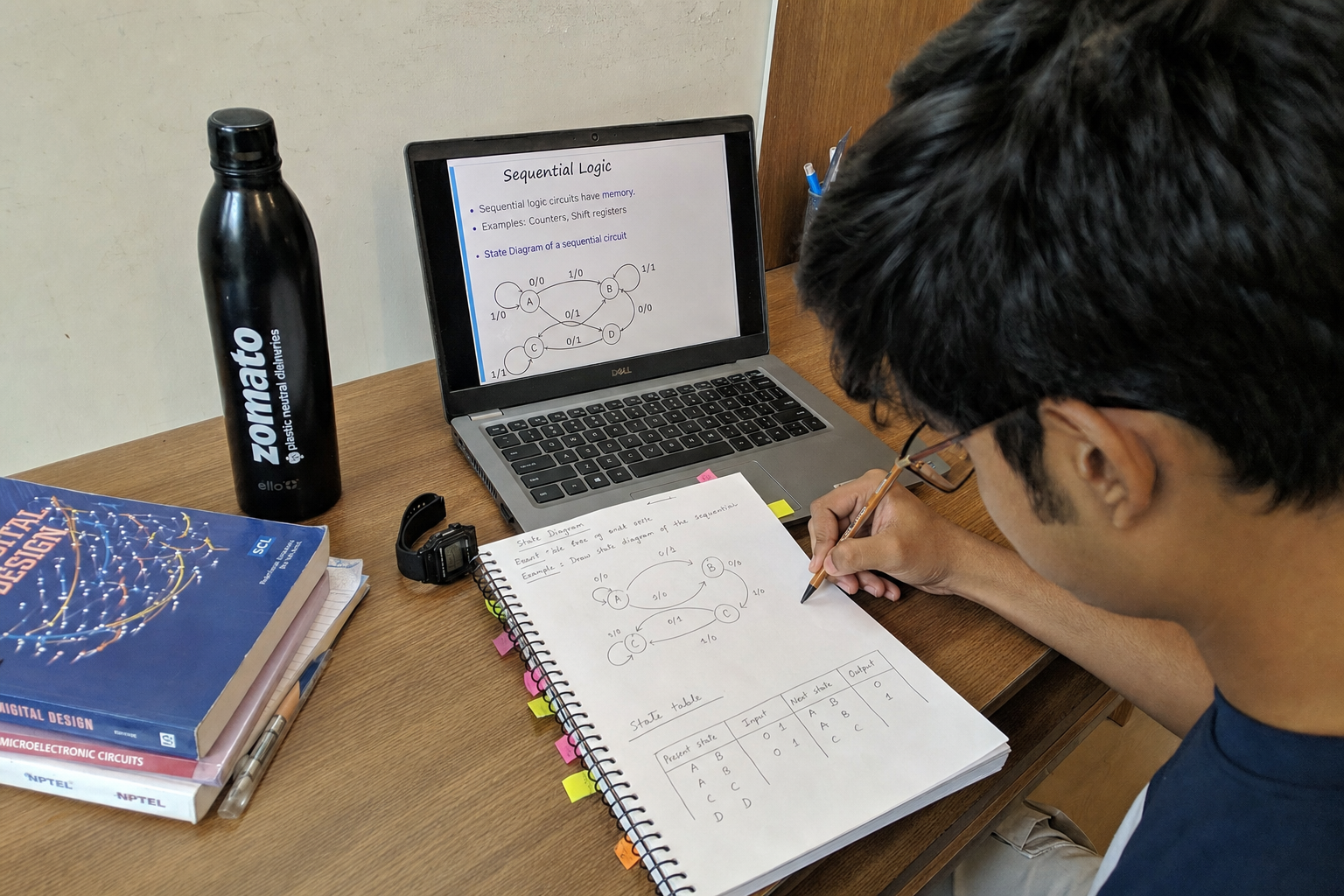
Begin every challenging prompt by restating outputs as functions of present state and inputs. Sketch the directed graph before algebraic manipulation unless the paper forbids diagrams explicitly. Label transitions unambiguously—ambiguous labeling loses marks faster than an algebraic slip because graders cannot infer charitable intent. Where Moore versus Mealy distinctions appear, annotate outputs on states versus transitions consistently with your notation key. If the question offers a partial table, complete missing rows methodically rather than jumping to minimal logic prematurely.
Canonical forms, minimisation discipline, and equivalence checks
Minimisation exercises reward structured search rather than wandering Karnaugh maps. Identify essential prime implicants first when the syllabus emphasises tabular methods; circle patterns deliberately and record cover reasoning beside each group. When Petrick or algebraic minimisation appears, show intermediate equalities so partial credit survives a late arithmetic mistake. After deriving expressions, perform a quick sanity check with two non-trivial input combinations if time permits; mismatches often trace back to mis-grouped corners rather than deep theory gaps.
State reduction questions tempt students to merge circles that look similar visually yet encode different output behaviour under future inputs. Enumerate distinguishing sequences conceptually: two states are potentially equivalent only if outputs match for every continuation relevant to the specification. Write short justification lines beside each merge on your rough sheet even if the fair-copy omits them—those lines become scratch anchors when you rewrite neatly.
Timing diagrams, races, and sequential intuition
Sketch waveforms with deliberate horizontal spacing so clock edges and propagation delays remain readable. Mark setup and hold windows lightly when the prompt references flip-flop parameters even qualitatively. If asynchronous resets appear, show assertion and deassertion relative to clocking discipline taught in your course. Practise translating word problems—“serial bit arrives MSB first”—into clock-cycle timelines without instantiating every gate-level delay unless explicitly requested.
Spend weekly drill sessions copying instructor waveforms, hiding labels, and attempting redraws from textual narratives alone. Compare against solutions to calibrate vertical ordering of signals—readable ordering saves minutes during inspection-heavy finals.
Randomized quizzes and mock intensity
When courses embed randomized quizzes, treat attempt caps seriously: each try should include pre- and post-mortem reflection rather than blind repetition. Log distractors you nearly chose and explain in one sentence why the correct option survives elimination rules. Pair quiz items with textbook lemmas so conceptual anchors multiply instead of fragmenting across isolated attempts.
Escalate difficulty gradually: start untimed accuracy blocks, then introduce bounded intervals mirroring exam station lengths. Track streaks of careless algebra separately from conceptual misses; address carelessness with mechanical drills such as copying tables slowly or speaking steps aloud quietly if allowed.
Answer presentation and partial credit hygiene
During finals, allocate ninety seconds to outline answer skeletons before expanding algebra. Reference diagram labels in prose whenever equations appear so graders map symbols quickly. If you detect time running short, prioritise defining states and transition conditions—even omitting full minimisation sometimes retains substantial marks compared to an unfinished algebra maze.
Review prior semesters’ rubrics if accessible; note whether explanatory paragraphs outweigh exhaustive gate drawings. Translate those priorities into personal checklists laminated mentally after each practice paper.
Collaborative sense-making without violating integrity
Discussion forums thrive when participants pose hypotheses and counterexamples rather than dumping unsourced answers. Explain why a guessed equivalent state merge fails using a single input sequence—that discipline mirrors examiner reasoning and reframes mistakes as durable lessons. Study groups rotate presenters weekly so everyone articulates minimisation narratives verbally.
Closing routines before the examination hall
Twenty-four hours beforehand, compress summaries onto two sheets: one for minimisation recipes and another for waveform sketch heuristics. Sleep adequately; sequential reasoning collapses when fatigue blurs edge ordering. Morning of, warm up with one moderate problem requiring diagram plus algebra—confidence matters psychologically even if final marks hinge on deeper weeks of preparation.
Carry forward the habit of narrating solutions aloud quietly during practice; hearing logical gaps reveals leaps that silent algebra hides. When results arrive, annotate returned scripts with error taxonomy tags so future semesters inherit smarter templates from day one.
Finally, remember STLD rewards staged storytelling from informal language to formal machines—master that translation layer and most examination variants become variations on a confident theme rather than unfamiliar shocks.
Deepening pattern recognition with sequence detectors and counters
Sequence detector templates—overlapping versus non-overlapping—should live in muscle memory. When a prompt describes a target substring, translate acceptance into states that track progress through characters or bits, then ask whether return transitions require sliding windows. Counters with enable, load, and synchronous clear appear constantly; narrate how each control line mutates the next state without opening a full K-map when the question is recognition-heavy. For shift-register variants, reason about left versus right movement of history bits and how parallel-load interacts with serial observation streams.
If synchronous versus asynchronous design philosophies collide in a hybrid prompt, isolate clocked elements first and push combinational clouds between registers second; graders appreciate layered decomposition even when final algebraic bundles remain intricate.
Rubric-aligned revision drills you can schedule fortnightly
Fortnight one emphasises correctness under generous timing; fortnight two halves durations while preserving accuracy targets above ninety percent; fortnight three mixes unseen prompts drawn from adjacent chapters to mimic departmental mash-ups. Track variance across attempts—rising variance signals unstable mastery despite rising averages. Interleave handwriting endurance sessions because prolonged finals punish wrists conditioned only to keyboard shortcuts.
Snap photographs of representative scrap-work sequences after mocks—later annotate digitally where organisation lapses triggered algebraic traps. Teaching assistants often note that half the lost marks trace to layout issues rather than raw ignorance. Adopt their feedback iteratively; rubrics sometimes reward communicative structure as highly as final binary answers.
State-machine excellence is less about memorising every theorem and more about narrating defensible design stories under stress—cultivate that voice during every practice hour.
Translating informal narratives into formal graphs faster
Practice converting paragraphs describing vending controllers, traffic intersections, or elevator scheduling into labeled graphs without algebraic distractions first. Name states using verbs or milestones learners intuit quickly—idle, counting, alarming—then tighten notation later. Encode implicit fairness constraints as guards on arcs instead of stuffing them into prose footnotes graders overlook. When narratives omit reset behaviour, explicitly add a reset arc consistent with course conventions rather than hoping ambiguity earns tolerance.
After drafting a graph, execute three verbal traces aloud representing worst-case input chatter; uncover orphan transitions early instead of discovering impossible stimuli mid-proof.
Closing discipline: restate the grading criteria your instructor emphasises weekly—diagram clarity, justification density, waveform fidelity—and rehearse answers that foreground those pillars before novelty flourishes.
Those habits compound quietly until examinations feel like rehearsed performances anchored in evidence rather than improvised scrambles every single time.
Leave a comment
Comments are moderated before they appear.